Breakfasting is rather an art I feel. It's of course a cliche that the first meal of the day is the most important, setting one up nutritionally and spiritually for the next 14 or 15 hours. Over the last week or so I've enjoyed very contrasting ways to break my fast. During our recent stay at my father's house it was variations on the grilled platter - sausages, bacon, black pudding, toast, eggs etc - that saw my weight rise and energy fall. I love all of those items, but perhaps once a week (or more sensibly once a fortnight) suffices to have them all together.
By way of contrast I feel full of beans (though they are not on the menu) after our habitual start to the day of strong (real) coffee, a homemade smoothie, and toast and marmelade or poached egg. Lord Emsworth, from what one can gather from the Blandings novels fared best on Dover sole, not something I've ever eaten before noon. We have in common, however, that something light and carefully chosen does make one feel at ease with the world. And of course we are both sound on pigs.
There is no 'right' breakfast in terms of a set menu. I've eaten curry in India and congee in Indonesia, pastry or rolls and coffee in the USA and France, steak in South Africa, black bread and blacker tea in the USSR, and felt good after all of them because the food satisfied not just my thirst and hunger but also a feeling of belonging and of well-being. How the kids I sometimes see eating crisps and drinking Red Bull on the way to school must feel I can only imagine. Not, sadly, important enough for their parents to have provided something more beneficial.
A lot of schools now are offering breakfasts to pupils, and it's not just the under-privileged who maybe need this - I know of a kid at a fee-paying establishment where it's not lack of money but parental laziness that sees him reportedly start his day more often than not on an empty stomach. That is sad in at least two ways - for his educational performance, but also for the missed moment of family bonding, of contentment and care that a simple breakfast can give.
It's a missed moment of culinary art too. Preparing the perfect poached egg is simple but rewarding - water barely simmering, a splash of vinegar because fresh eggs (as they should be, and with our own chickens are here) tend to disintegrate without it, eggs carefully broken and slipped into the water (I don't see the point of the cheffy whirlpool thing), drained and en-toasted when the yolks are runny and the whites soft but formed - it's a skilful ritual worth the effort.
Showing posts with label toast. Show all posts
Showing posts with label toast. Show all posts
Thursday, 9 April 2015

Monday, 28 April 2014
Food and Exams
SC has his first A level exam (of sorts, it's a physics practical) today. As a concerned parent (far more nervous than he appears to be) I want to help in every way possible. Though his school is older, he doesn't go to one of those privileged establishments where rumour has it a certain amount of clandestine assistance is given to candidates, thus help here in large part means giving him a good breakfast.
So what is a good exam breakfast? Thinking it through I failed to come up with anything terribly revolutionary, but then most nutritional thought in the end seems to come down to common sense. He will benefit from slow release carbs, to give energy through a good part of the day, so a couple of slices of wholemeal bread (he isn't keen on toast). Protein with that to slow the digestion of the starch into sugar, spreading the energy longer (the exam late in the school day), so some low fat ham with his bread (and scrape of butter). Such protein is supposed to be good for concentration too. I sneaked some fish into yesterday's mezze for a similar reason, and because as a true believer in Wodehouse I hope that what Bertie felt made Jeeves so brainy will work on SC.
Fresh fruit and veg seems to help our moods, the vitamins perhaps giving us a boost, so a fruit platter - orange, apple, peach, blueberries - shared between us, and some cloudy apple juice to wash everything down. To finish a zero fat vanilla yoghurt not for any real scientific reason, but because it tastes like ice cream and makes one happy (longer term of course it's good for his bones, but the danger of osteoporosis is a few decades off for him yet).
In the end however balanced such a start may be, when the papers are opened it's down to other factors. But when the course of someone's life can vary because of just a single mark tipping them up or down a grade, you want to give them every chance.
So what is a good exam breakfast? Thinking it through I failed to come up with anything terribly revolutionary, but then most nutritional thought in the end seems to come down to common sense. He will benefit from slow release carbs, to give energy through a good part of the day, so a couple of slices of wholemeal bread (he isn't keen on toast). Protein with that to slow the digestion of the starch into sugar, spreading the energy longer (the exam late in the school day), so some low fat ham with his bread (and scrape of butter). Such protein is supposed to be good for concentration too. I sneaked some fish into yesterday's mezze for a similar reason, and because as a true believer in Wodehouse I hope that what Bertie felt made Jeeves so brainy will work on SC.
Fresh fruit and veg seems to help our moods, the vitamins perhaps giving us a boost, so a fruit platter - orange, apple, peach, blueberries - shared between us, and some cloudy apple juice to wash everything down. To finish a zero fat vanilla yoghurt not for any real scientific reason, but because it tastes like ice cream and makes one happy (longer term of course it's good for his bones, but the danger of osteoporosis is a few decades off for him yet).
In the end however balanced such a start may be, when the papers are opened it's down to other factors. But when the course of someone's life can vary because of just a single mark tipping them up or down a grade, you want to give them every chance.
Saturday, 1 March 2014
Bread, Toast and the Meaning of Life
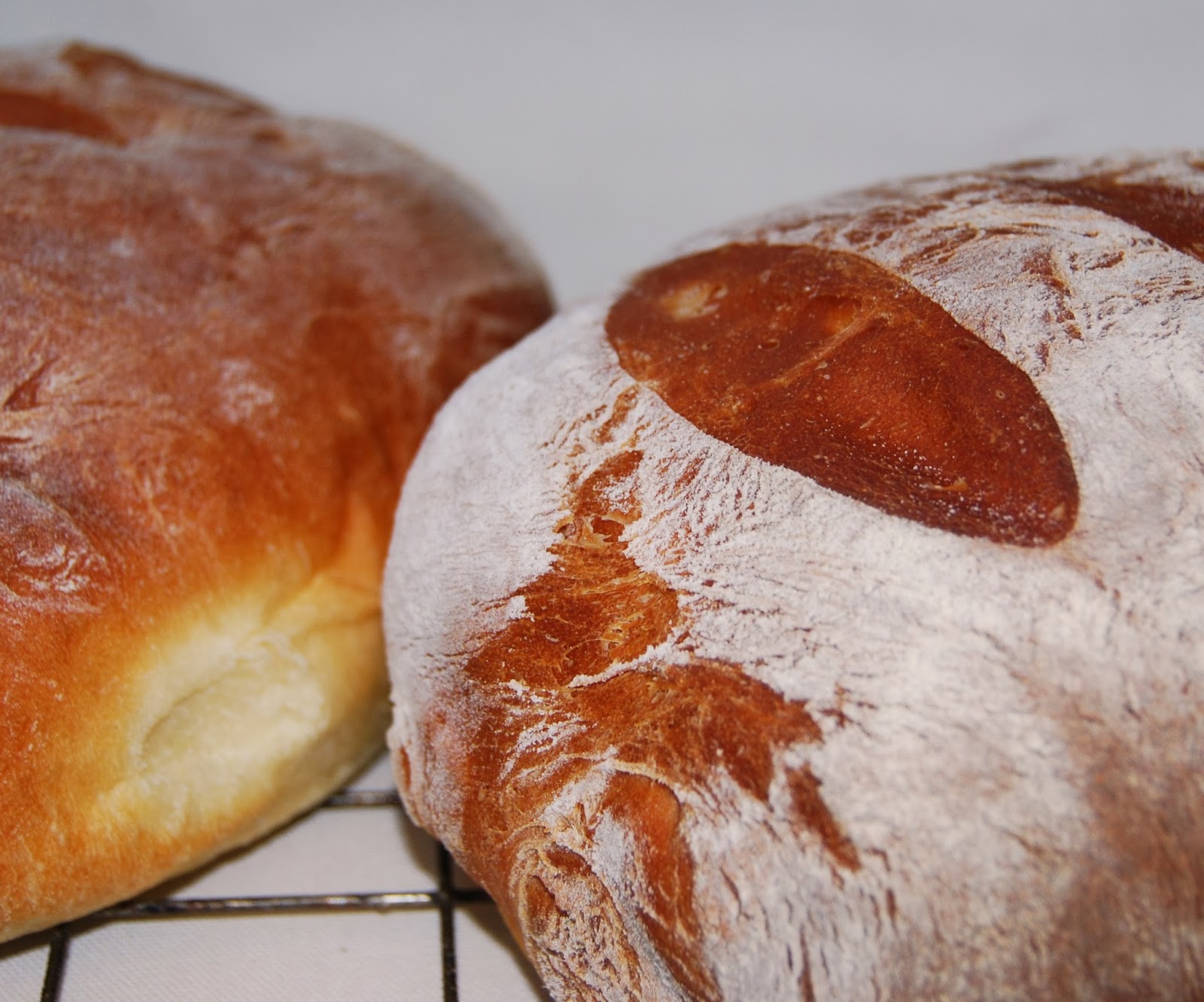
Fed up with the poor quality of bread available here I've experimented with recipes of late to make my own, resulting in one that's tasty, has yet to fail, and looks rather lovely. The one thing lacking is a crispy crust.
Bread-making is an area where bucket-cookery won't work, so I have a precise recipe:
1.25 cups water
2 tbsps olive oil or walnut oil
a beaten egg added to the water
1.25 tsp salt
2.25 tbsps sugar
2.25 tbsps milk powder
4 cups strong white flour
7g sachet of fast acting yeast
I use a bread-maker on its dough setting to mix and rise the bread, then knock it back and kneed it briefly. That quantity makes two good-sized loaves, the top slashed in three or four places with a thin-bladed knife to make a pretty surface and a different texture when the cuts expand.
The loaves on a flat griddle are left to rise in a warm cupboard for at least two hours, then put in a cold oven and the oven turned on to 200C. They're cooked in about 25 - 30 minutes, then left on a cooling rack (fresh out of the oven, smelling wonderful, it's a tempter, but until the crumb has formed they are not right).
As far as austerity is concerned it's not a bad deal either, our eggs free, or sort of, from our chickens, and if I use Sainsbury's white bread flour at £1 for 1.5kg I reckon I get six of those loaves from one bag. Add 14p for a yeast sachet and pennies for the rest and a life-enhancing and delicious loaf costs, even with the energy needed, less than 50p. As regards those energy costs, I'm careful to make the bread before or with something else, so they're not extravagant.
But it's really not the cost that is paramount, but having bread that looks good, smells good, tastes good. Bread is such a fundamental thing to so much good eating. Soup with nice bread becomes a meal, for example. And toast at breakfast should be a basic human right.
The egg in this recipe gives the crumb a faint yellow tinge that becomes more obvious when the bread is toasted (and it toasts superbly). On Sunday morning drinking good coffee, eating toast and jam after bacon and egg, all was right with the world. Ours anyway.
Bread-making is an area where bucket-cookery won't work, so I have a precise recipe:
1.25 cups water
2 tbsps olive oil or walnut oil
a beaten egg added to the water
1.25 tsp salt
2.25 tbsps sugar
2.25 tbsps milk powder
4 cups strong white flour
7g sachet of fast acting yeast
I use a bread-maker on its dough setting to mix and rise the bread, then knock it back and kneed it briefly. That quantity makes two good-sized loaves, the top slashed in three or four places with a thin-bladed knife to make a pretty surface and a different texture when the cuts expand.
The loaves on a flat griddle are left to rise in a warm cupboard for at least two hours, then put in a cold oven and the oven turned on to 200C. They're cooked in about 25 - 30 minutes, then left on a cooling rack (fresh out of the oven, smelling wonderful, it's a tempter, but until the crumb has formed they are not right).
As far as austerity is concerned it's not a bad deal either, our eggs free, or sort of, from our chickens, and if I use Sainsbury's white bread flour at £1 for 1.5kg I reckon I get six of those loaves from one bag. Add 14p for a yeast sachet and pennies for the rest and a life-enhancing and delicious loaf costs, even with the energy needed, less than 50p. As regards those energy costs, I'm careful to make the bread before or with something else, so they're not extravagant.
But it's really not the cost that is paramount, but having bread that looks good, smells good, tastes good. Bread is such a fundamental thing to so much good eating. Soup with nice bread becomes a meal, for example. And toast at breakfast should be a basic human right.
The egg in this recipe gives the crumb a faint yellow tinge that becomes more obvious when the bread is toasted (and it toasts superbly). On Sunday morning drinking good coffee, eating toast and jam after bacon and egg, all was right with the world. Ours anyway.
Sunday, 17 November 2013
Something More on Toast - Student Survival (Again)
I'm a great believer in simplicity in the kitchen, or the home kitchen at any rate. For a domestic cook it's clearly easier to get something quite basic right than to master some 13 stage three days of preparation grind your own hand-picked spices splendour. Though I love cooking I don't necessarily want to spend my whole day in the kitchen. I also think that in cookery as with children mixing paint and anyone unskilled mixing cocktails if you have too many ingredients you end up with brown.
The colour of my breakfast this morning was indeed brown, or at least grey-brown, but the flavour was wonderful. Four quite large mushrooms sliced, fried gently in a little butter till the juices ran, a tsp of plain flour stirred into the juices and cooked for a minute or two, then a bare sherry glass of milk stirred in and cooked until there was a shiny sauce that spooned onto toast was thick enough not to soak into it. Salt, pepper, eat. As with a previous post about a boiled egg I took huge pleasure in getting something as good as it can be, a very rare moment.
An aside: why does that sauce, made with flour, need only a brief simmer to lose the floury flavour?
As my son gets nearer to university age I'm thinking more and more about the sort of economic and simple dishes students should be able to cook. I think he will be able. Those creamed mushrooms, with more toast to fill the bottomless stomach of youth, would suffice for the day's lighter meal. And it would cost well under £1. Substitute two baked potatoes (one of the few things I cook in the microwave - quicker, cheaper, and no loss of flavour) for the toast and it's a substantial main course, still with intelligent shopping less than £1. How many students have the resources to do that, though, compared to the number living off supermarket pizza?
The colour of my breakfast this morning was indeed brown, or at least grey-brown, but the flavour was wonderful. Four quite large mushrooms sliced, fried gently in a little butter till the juices ran, a tsp of plain flour stirred into the juices and cooked for a minute or two, then a bare sherry glass of milk stirred in and cooked until there was a shiny sauce that spooned onto toast was thick enough not to soak into it. Salt, pepper, eat. As with a previous post about a boiled egg I took huge pleasure in getting something as good as it can be, a very rare moment.
An aside: why does that sauce, made with flour, need only a brief simmer to lose the floury flavour?
As my son gets nearer to university age I'm thinking more and more about the sort of economic and simple dishes students should be able to cook. I think he will be able. Those creamed mushrooms, with more toast to fill the bottomless stomach of youth, would suffice for the day's lighter meal. And it would cost well under £1. Substitute two baked potatoes (one of the few things I cook in the microwave - quicker, cheaper, and no loss of flavour) for the toast and it's a substantial main course, still with intelligent shopping less than £1. How many students have the resources to do that, though, compared to the number living off supermarket pizza?
Monday, 26 August 2013
A Tiny Piece of Perfection
Yesterday I cooked the perfect boiled egg. Actually I cooked two, one for my wife and one for myself. Not the greatest culinary feat ever, but very pleasing in its own little way, not least in that they formed the basis of our breakfast, and eventually of some debate.
Firstly, who is to define what constitutes a perfect boiled egg? Had my son been up at that time (not going to happen during the holidays unless fishing is in prospect) he would have pointed out that his perfect boiled egg is hard enough to damage plaster if thrown. These had soft but solidified whites, the very edge of the yolk had hardened, but the rest was liquid and cried out for toast soldiers (or peace women as a distant cousin dubbed them long ago).
Secondly, the comparative value of such small but perfect things. I maintain that I would rather have had that egg than a mediocre but exotic restaurant dish, just as I'd take a Hilliard miniature over any large scale piece of crap by Hirst. The egg would cost less than the Blumenthal crab meat and goat's testicle on rocket and pissenlit salad with dressing made from the distilled tears of a depressed cat, but cost is irrelevant here.
The method, by the way, as this is meant to be a food blog (and chefs have come to blows over their preferred ways of cooking boiled eggs): small saucepan of water brought to the boil, two medium eggs then added, wait till the water returns to the rolling boil, then start the ancient egg-timer going. Remove eggs when the sand has run out (wait a bit for larger eggs, remove earlier for small ones), place in egg cups and leave for a minute to firm up. Cut off top with knife (and like all sensible people I'm a Little-endian), add a few grains of salt and dig in.
Just realised that I left one important factor out of the above: the eggs were from our hens, so at most two days in the basket, and produced by creatures who along with their layers' pellets eat grass, worms, wood-lice (their favourite find), our salad discards, grain and if we don't rescue them in time the occasional little frog.
Firstly, who is to define what constitutes a perfect boiled egg? Had my son been up at that time (not going to happen during the holidays unless fishing is in prospect) he would have pointed out that his perfect boiled egg is hard enough to damage plaster if thrown. These had soft but solidified whites, the very edge of the yolk had hardened, but the rest was liquid and cried out for toast soldiers (or peace women as a distant cousin dubbed them long ago).
Secondly, the comparative value of such small but perfect things. I maintain that I would rather have had that egg than a mediocre but exotic restaurant dish, just as I'd take a Hilliard miniature over any large scale piece of crap by Hirst. The egg would cost less than the Blumenthal crab meat and goat's testicle on rocket and pissenlit salad with dressing made from the distilled tears of a depressed cat, but cost is irrelevant here.
The method, by the way, as this is meant to be a food blog (and chefs have come to blows over their preferred ways of cooking boiled eggs): small saucepan of water brought to the boil, two medium eggs then added, wait till the water returns to the rolling boil, then start the ancient egg-timer going. Remove eggs when the sand has run out (wait a bit for larger eggs, remove earlier for small ones), place in egg cups and leave for a minute to firm up. Cut off top with knife (and like all sensible people I'm a Little-endian), add a few grains of salt and dig in.
Just realised that I left one important factor out of the above: the eggs were from our hens, so at most two days in the basket, and produced by creatures who along with their layers' pellets eat grass, worms, wood-lice (their favourite find), our salad discards, grain and if we don't rescue them in time the occasional little frog.
Friday, 23 November 2012
One Flame Cooking Chapter 3 and a Bit
With Sternest Critic absent at a party I will be able to indulge a culinary passion that he frowns upon - kidneys. Sunday breakfast sorted.
Joyce's famous line: 'grilled mutton kidneys with a fine tang of faintly scented urine', is frequently quoted, but is no advert for what is one of the best things you can eat, and I'd always go for lamb's kidneys fried.
They fit the austerity bill - especially from a butcher's shop where they can often be had at bargain prices - and the health bill too, low fat and full of vitamins. If you go to some supermarkets you'd think that sheep had stopped growing kidneys.
Kidneys are ideal one flame cooking candidates too: sliced open and white gristle removed, fried gently in butter, the red juices mixing with the fat to make a simple sauce to which a good dab of mustard is added, with a spoon of stock and/or cream if available. Something more substantial evolves if quartered mushrooms are fried with them, their grey juices adding to the reddy-brown ones from the offal.
Served on toast (another of Alan Bennett's somethings on toast) or bread to soak up the gravy this is a dish for those who enjoy forthright tastes. Tunes can be played with paprika, Tabasco, or chili sauce providing extra layers of taste to the jus (I hate that word but it's useful), though plain and simple is good. One of my abiding childhood food memories is of eating kidneys on toast on my knees while watching the kids' cartoon Jonny Quest, the moment fixed by the flavour and scent.
And kidneys are very special too as regards texture, something we tend to ignore or relegate to an afterthought in British cooking. The Japanese and Indonesians cook with texture as much in mind as flavour. The feel of teeth penetrating a meaty kidney is about as good as culinary texture gets, for me at least.
Joyce's famous line: 'grilled mutton kidneys with a fine tang of faintly scented urine', is frequently quoted, but is no advert for what is one of the best things you can eat, and I'd always go for lamb's kidneys fried.
They fit the austerity bill - especially from a butcher's shop where they can often be had at bargain prices - and the health bill too, low fat and full of vitamins. If you go to some supermarkets you'd think that sheep had stopped growing kidneys.
Kidneys are ideal one flame cooking candidates too: sliced open and white gristle removed, fried gently in butter, the red juices mixing with the fat to make a simple sauce to which a good dab of mustard is added, with a spoon of stock and/or cream if available. Something more substantial evolves if quartered mushrooms are fried with them, their grey juices adding to the reddy-brown ones from the offal.
Served on toast (another of Alan Bennett's somethings on toast) or bread to soak up the gravy this is a dish for those who enjoy forthright tastes. Tunes can be played with paprika, Tabasco, or chili sauce providing extra layers of taste to the jus (I hate that word but it's useful), though plain and simple is good. One of my abiding childhood food memories is of eating kidneys on toast on my knees while watching the kids' cartoon Jonny Quest, the moment fixed by the flavour and scent.
And kidneys are very special too as regards texture, something we tend to ignore or relegate to an afterthought in British cooking. The Japanese and Indonesians cook with texture as much in mind as flavour. The feel of teeth penetrating a meaty kidney is about as good as culinary texture gets, for me at least.
Thursday, 22 November 2012
Something on Toast
One of my favourite pieces of food criticism was an off-the-cuff remark by Alan Bennett. It is said that years ago when he saw the fancy salads and international cuisine in the BBC canteen he remarked in exasperation: "You don't want that, you want something on toast."
As with his plays there are layers of thought behind simple words. Simplicity is good; toast is comforting and provides a carb boost (though he would never stoop so low as to use the non-word carb); and there is something very British about 'something on toast.' Sardines, beans, egg, cheese...
My wife and I - before we in contemporary parlance 'hooked up' - both spent three months in what was then the USSR. She was in provincial Voronezh where food was scarce and facilities limited: the thing she still talks about craving was toast - bread, generally the black bread beloved of the Russians, was available if you looked, but no means of toasting it. She claims that dreams of toast haunted her sleep.
This morning, our youngest hen having kicked in at last with an egg, we celebrated the fact with scrambled eggs. A dash of milk, a lump of butter, and five eggs whisked together in the pan. I won't do them now in the microwave, as these invariably end up as a solid mass. So creamy scrambled eggs on wholemeal toast, and all is right with the world for a few minutes of satiety. It does not take much. Just something on toast.
As with his plays there are layers of thought behind simple words. Simplicity is good; toast is comforting and provides a carb boost (though he would never stoop so low as to use the non-word carb); and there is something very British about 'something on toast.' Sardines, beans, egg, cheese...
My wife and I - before we in contemporary parlance 'hooked up' - both spent three months in what was then the USSR. She was in provincial Voronezh where food was scarce and facilities limited: the thing she still talks about craving was toast - bread, generally the black bread beloved of the Russians, was available if you looked, but no means of toasting it. She claims that dreams of toast haunted her sleep.
This morning, our youngest hen having kicked in at last with an egg, we celebrated the fact with scrambled eggs. A dash of milk, a lump of butter, and five eggs whisked together in the pan. I won't do them now in the microwave, as these invariably end up as a solid mass. So creamy scrambled eggs on wholemeal toast, and all is right with the world for a few minutes of satiety. It does not take much. Just something on toast.
Tuesday, 13 November 2012
Starter, Side, or Supper? (and Inadvertent One Flame Cookery)
I had some kale from our allotment to use yesterday, so fell back on something mentioned on a previous post - remove the stems, wash (very carefully in salted water, it often harbours scale insects and the occasional tiny slug, though supermarket stuff almost certainly just needs a quick rinse) and steam the leaves, then cut them fine and add a boiled egg or two, a tin of anchovies and their oil, some crushed garlic, and a good grating of parmesan. All this chopped together and mixed up is put still warm on hot buttered toast. The flavours are not exactly subtle, but on a damp November evening robust is good.
When I was planning our evening meal I had this in mind, and tried to think of how to turn it from what is a good starter or maybe a side dish, into a main course. Potatoes, rice or pasta would be inappropriate. Another veg in it would be too much, even finely diced onion. A vegetable with it seems weird. The only thing that tempted me was adding a fried mushroom or two (with hindsight perhaps steaming one or two briefly would be better), but even that didn't get my vote. The only way I can think of (any ideas gratefully received) to make this a main course would be to do lots of it, but good though it is...
So some things are perhaps not meant to be a full supper, or dinner, or tea, depending on how you style your main meal. Pity, as it is cheap, tasty, nutritious, and just takes ten minutes to knock up. I ended up making a small amount of spaghetti with meat balls (three sausages to use up) and mushrooms and a simple tomato sauce to follow it.
Though it was not what I had in mind when actually making it, if you boil the egg first this is another one flame cooking thing (provided you have a toaster, though good crunchy bread would be equally good), and a very healthy one too. And there is a minimum of washing up, always a plus.
Subscribe to:
Posts (Atom)