While I enjoy making dishes with posh ingredients, it makes my peasant heart happy to do so with common stuff.
On the posh side, we had a simple pasta course at the weekend, just ribbed (for your pleasure, and to pick up the sauce) tubes and a small but expensive tin of black truffle slices in olive oil. Add grated Parmesan and that's it. Delicious.
On the simple side, a recent curry made with dried lentils, loads of sliced onions and garlic, a grated thumb of ginger, and a tin of coconut milk. With spices to perk it up of course. It was slurpy (the lentils cooked to dhal doneness), filling and of course cheap(-ish), and for once I got the spice balance right - a hint of heat, a lot of taste.
As so often the difference in kitchen terms between the two was time. The pasta and truffle thing took 10 minutes. The curry in all needed over an hour - 10 mins to boil the rinsed lentils, 35 more to simmer them, add to the sauteed onions and mix with the coconut milk then bubble gently away for another quarter of an hour to let the ginger, garlic and spices blend in and flavour the whole pan.
I loved both meals, but maybe because I enjoy the faffery, or possibly because the curry cost by my reckoning £2.50 (coconut milk from the Indian supermarket undercuts Messrs Sainsbury and Aldi by about 33%) it was the latter that pleased me most.
Showing posts with label garlic. Show all posts
Showing posts with label garlic. Show all posts
Tuesday, 10 December 2019

Tuesday, 26 November 2019
Super Stock
I love making stock so much that it's probably the most enjoyable part of cooking a chicken. It's cheap, delicious, can be altered in a thousand ways so it's never dull, and is the basis of innumerable great dishes.
With the carcass of a roast chicken to use up last week it actually fell to the Dear Leader (may her detractors shrivel like salted slugs) to start the stock off, a rare foray into the kitchen other than in an advisory capacity. To the carrots, onions, ginger and bay leaves she had incorporated I added a few rather tired but usable sticks of celery, a head of our own garlic, one of the few left from a disappointing season, and a load of spices - black cardamom pods, red and black peppercorns, some coriander seed, a star anise, some allspice berries... The more flavour you put in, the more you get out.
Once the initial albumen scum has been cleared from the surface, watching it give occasional little blips is a therapeutic exercise, repeated over a good two and a half hours as the liquid simmers ever so gently to maximise the flavour without clouding up. The aroma wafting up through the house is another mood lifter. And of course the end product is life-enhancing - tasty, complex, savoury, like a good wine but without the after-effects. As soon as the cooking is over I like to strain the liquid off the veg and bones, as left to cool on them it can develop some stale undertones.
As you'd expect with an ingredients list like that, the first use I made of the finished article was in a Chinese dish, a mushroom and vegetable-rich noodle soup-cum-stew into which, inauthentically, we stirred spoonfuls of the Mexican-inspired chili sauce made by Sternest Critic to preserve our bumper chili crop remains. A good soup needs a very good stock - I recall (probably not for the first time, my apologies) Chris Johnson, then owner of The Village Restaurant in Ramsbottom, being very upset that having paid £20 (and this in the early Nineties) for a bowl of soup in an extremely famous French restaurant owned by an extremely famous French chef, the stock was watery and boring. It spoiled what should have been - if critics were to be believed - the meal of a lifetime.
No such problem with our bowl of Chinese-y goodness. It was warmly spicy, onion sweet, and deep in colour and flavour. Satisfying to the palate, soothing on the stomach, and warming for the soul - and for pennies.
Thursday, 21 February 2019
A Rainbow on Your Breakfast Plate - and in Your Gut
We - the Dear Leader, the temporarily-home-before going-off to-Gozo Sternest Critic, and your humble servant - are on a weight loss quest for a time. Well, weight loss and health drive. That means the occasional 800 calorie day, and generally eating somewhere between 1000 and 1500 calories, with a day off every now and then. That may sound restricting, and in the mathematical sense it is of course, but to be doable without becoming boring it does mean getting creative.
Our breakfasts, except when staying in hotels or at Christmas when bacon and sausages rule, are usually pretty healthy. Currently they are - thanks Donald - bigly so. And not in a bad way - no kale smoothies, in fact given we learn from Michael Moseley that smoothies go straight through the gut and mean a sugar rush, no smoothies at all. But every morning for the past fortnight we have enjoyed a bowl of fruit (along with e.g. poached egg on wholegrain toast of some sort). Again I've tried hard to avoid that being dull, leading to me hitting the local Asian supermarket, and looking out for what's good in Morrison's, Waitrose and Sainsbury's.
Today, for example, we had cherries, kiwi, blueberries, and golden plums (£1 for a punnet of eight or ten), with a squeeze of perfumed Egyptian lime, tiny little fruits that lift flavours even more than ordinary lemons do. Tuesday we had dragon fruit and guava with some more workaday stuff. I love guava, in spite of ripe ones smelling like men's locker room sweat. The local Chinese shop had durian in, but you have to draw the line somewhere, and fruit that smells like poo is one good place.
What is austerity in this? Eating fruit is not expensive. It takes a bit of effort to seek things out, but Morrison's wonky blueberries that contributed to two for the three of our breakfasts cost 84p. I defy anybody to explain how they were wonky too. Wonky kiwis (maybe 1.358mm shorter than non-wonky?) I think were 70p for a pack of eight. I use one sliced into six to add luminous green to the plate. Little oranges another bargain; likewise grapefruit reaching its sell-by-date and no different to full price ones in feel or as it turned out flavour for 25p. I buy full price stuff too, and dragon fruit are not cheap, but overall breakfasts for the week don't break the bank.
It's cheering to see something so lovely on the morning platter. Great for the body too, with loads of fibre (kiwis for me qualify as superfoods, though shops aren't allowed to use that word now) and vitamin C, and stuff that is good for the eyes but I can't spell. Blueberries are supposed to help the memory, per clinical tests, but they taste fab with lemon or lime on them. Cherries have some special phytonutrients that you don't find in many other foods. It won't harm your - what a very British word - regularity either.
Reading Michael Moseley's Clever Gut Diet book - he is to diet and health what HFW is to ethical food - as part of the current drive to lose a bit of weight one tip was to help your biome's diversity by eating 30 different fruits and vegetables in a week. We did that in two days, and after three are on 42 and heading ever onward. Tinned stuff in there for pennies; our own veg still (PSB, swiss chard, sprouting seeds, kale and leaks at present, we had too the last of our stored squash on Monday and some of our own stored garlic, along with loads of herbs that I haven't counted in the total); wonky or (per Sainsbury's) greengrocers' F&V are super cheap. And some fruits are reduced in price (like cheese) when they are approaching ripeness.
[Standing up] I am not Spartacus. Nor am I vegetarian. Friday's evening meal will be steak for SC and me, fish for the DL. But for our own good, and with more than a nod at helping the only planet we have to live on, and because they are so tasty, F&V make up the bulk of our nutrition. If that sounds poncey, my apologies. Lunch today will be baked beans on toast. Demotic and delicious.
Monday, 29 October 2018
Simply (Sometimes) the Best
Given my undoubted obsession with variety, and ensuring our nutrition is tickety boo, main course dishes here accordingly tend to include quite a few different veg etc. Sometimes it's good to focus on one thing, however, to give it due respect and a chance to shine.
Last night's main course, with The Dear Leader still struggling with her jaw (a corn cob injury, weirdly) and needing softish foods I went with something from the classic repertoire - a fancy version of French onion soup (think the posh French name is Panade). It is my kind of cooking anyway, in several ways - onions are, like me, cheap. It requires slow cooking and a lot of therapeutic peeling and slicing (without tears for once), and watching carefully until it achieves that perfect mahogany shade of brown. And this version entailed opening a bottle of wine that forms part of the cooking liquid, (along with beef stock), so we had to finish off the rest. Thickened with flour (darling, nobody does that these days), then enriched with loads of grated Gruyere and a good slug of Cognac (best thing for it, I'm a (married) single malt man), it was the ideal thing for a gloomy autumn evening.
That approach, focusing on one big element, is suited to soups, though I'm a fan of the French hotel using-up-bits-of-leftover-veg option too. Recently we had an enjoyable Jerusalem artichoke soup, though that had the backing of carrots and onions, with the fine flavour of those tubers given free rein; and on Saturday a pumpkin was very much to the fore in another potage (not so fine, but TDL like it). Having mistakenly overdone the carrot purchasing we're likely to have Potage de Crecy this week too. I need to go to my favourite Asian supermarket to buy another net of their excellent and incredibly cheap garlic, to go for a Spanish sopa de ajo, using three or four heads of the stuff. All this veg may be good for us (and especially our blood apparently, as far as the garlic and onions are concerned), but it is just as well we have the heavy winter duvet on the bed. Enough said.
Sunday, 26 June 2016
Something New
It is always a pleasure to come across a new combination of ingredients, a new dish, that works, especially if it is simple. With a glut of broad beans from our allotment (no complaint there, just an observation) I was looking for a way to do something different with this vegetable that doesn't lend itself to all that many exotic uses. There are dips and hummuses (hummi?) that suit it well, but none met our needs on Friday. As so often the divine Hugh F-W offered a direction, if not the solution itself.
HFW suggests zapping the cooked older beans (once the grey and bitter skin has been removed) and mixing with a little garlic and a thrutch of ricotta. He may not have used the word thrutch. I had ricotta in the fridge, and am never without garlic, but as our beans are fresh and young making a puree of them didn't appeal, indeed it seemed just wrong, so I warmed six thinly sliced cloves of garlic (HFW suggested two) in a little butter and olive oil, added a heap of the jade gems, and stirred in half a container of ricotta (about 125g).
When the lot was well mixed and warmed through it was piled on a toasted flatbread and became the nearest thing we had to a main course that evening. All three of the ingredients (discounting the flatbread) married beautifully, the garlic was very present but not dominant, the texture moist and toothsome, and The Dear Leader (all hail our Dear Leader, ever vigilant guardian of the homeland) fulsome in her praise.
The combination was so good that to demonstrate it to the returning Sternest Critic I repeated the exercise and served the beans as an accompaniment to the customary fatted calf (thick steak) enjoyed when he is just back from university. He is not a big fan of the broad bean, but made short work of these.
Only one thing bothers me slightly about the dish, and that is the thought in the back of my mind that it is not a million miles from The Fast Show's cheesy peas.
Friday, 6 November 2015
Only the Lonely
Midweek the Dear Leader was away overnight on teaching duties (Fortifying Your Secret Island 101), and Sternest Critic was staying an extra night of his 'reading week' at university before venturing home for his version of R&R, S&S (sleep and steak). I was thus left alone, and was just looking to make a quick and simple supper, and to enjoy something that I would not have cooked if enjoying company.
There are some things that are best eaten alone: curried sprouts probably head that list, with the sauce I made for penne pasta - a sort of reformed putanesca - not far behind. Olive oil was warmed with sliced garlic (lots), and a red chili snipped into it in the vain hope of avoiding chili-eye, then a whole tin of anchovies chopped and added with their oil. When they were all melted together and vaguely cooked through three fresh tomatoes minus their skins were grated in and the lot heated to bubbling point. With lots of pepper and salt and a generous amount of grated parmesan it was utterly delicious, but must have given me breath like a particularly unhygienic medieval French peasant's.
Kippers I feel qualify for the best eaten apart list, unless both of you indulge. When we were on Islay and Jura last summer I opted for kippers at breakfast a couple of times, while DL went for something that when we were in the car later in the day was less assertive. But these foul smelling things (sprout curry apart) do tend to be very tasty. The exception is durian. I had heard much about it so when given the chance to try some (in Johor Bahru, just over the causeway from Singapore into Malyasia) I did. The smell, people said and wrote, is vile, but the taste sublime. They were right about the smell - think a long untended septic tank - but not the taste, which I'd describe as mildly mucal watered down mango. That is something best eaten by other people.
Monday, 20 April 2015
Time's Cruel Quirks, and Kinder Ones
As I speed through the third decade of my thirties time, its benefits, passing and cruel jokes at our expense has begun to assume more significance than it did in my salad days (accompanied in the Sixties and Seventies of course by Heinz salad cream). With experience has come a reasonable knowledge of restorative beverages, and the money to pay for a decent standard thereof. But annoyingly once we are of a certain age the body's tolerance for alcohol reduces, so an evening of anything more than mild conviviality can leave one feeling delicate next day. Thus we try to drink well rather than lots.
A new quirk of maturity hit me recently. Enjoying a night's sleep a month or so back I began what seemed destined to be that very rare pleasure, a sex dream. I make no apologies for my subconscious. Several (it would appear said subconscious is decidedly ambitious) of my wife's former colleagues (attractive female ones) were seated around our table with the Dear Leader, all dressed somewhat inappropriately for the March weather, though despite them being seated at a round table I could only see their backs wherever I stood. I sported an apron, and nothing else.
Tragically the dream took a diversion. For their meal I was preparing pork sausages (way ahead of you Sigmund) fried then sliced on the bias and the flat faces browned, with apple juice added to the pan to caramelise and create a sticky jus. The dream had become culinary not carnal. I focused on what heat would be needed to keep the apple flavour but make a nice syrupy sauce to grace the meat, and if it needed herbs (I now, fully conscious, think a touch of sage). Even in the dream I felt this was missing the point, but was seduced by the simple recipe idea, rather than as might have been hoped the company.
Carpe diem seems very brusque, however rapidly time is racing. Whatever the latin for embrace in place of seize seems more inviting. We did that yesterday by planning for the promised sun. A lamb shoulder on a generous bed of sliced leeks (picked the day before on the allotment) and bruised garlic cloves went into a very low oven (110 celsius) mid-morning, a bottle of Christmas-leftover Babycham (the Dear Leader enjoys retro sometimes too) to keep it all moist. A lidded pot let the whole steam gently. When we ate in the garden mid-afternoon the sun shone, the meat fell off the bone, and the sweet mushy alliums and a big serving of steamed Red Russian kale were ideal partners. As was a half-bottle of Rioja. Should we regret not having the head anymore for a full midday Sunday bottle, or celebrate having the nous to construct such a pleasant hour?
Monday, 10 February 2014
How Much Garlic is Too Much?
I'm a great reader of old cookery books. Or maybe food books is a better description - I find those with a succession of neatly laid out recipes and no intellectual exploration dull in the extreme. If you read any from the 1970s and earlier you'll see garlic given as an optional ingredient 'if liked'. We like.
Yesterday I roasted a chicken (not one of our garden variety) atop a whole bulb of the stuff, each clove carefully skinned before use. It was garlic as vegetable (eventually incorporated in the whooshed sauce) rather than flavour enhancer. As I wet roasted the bird the cloves softened in the liquid, leaving them incredibly sweet without caramelising at all. The bottom floor had a nice garlicky aroma, but this morning that had gone as you'd expect, and none of us had garlic-breath, that maybe you wouldn't.
In my extremely late thirties health and food have become closely linked. A friend with whom a fortnightly pint was shared died suddenly last summer, bringing such matters into stark perspective. I often wonder about our diet - wide variety of styles and ingredients, nothing deep fried, moderate drinking (though while we're on the topic, which bastard thought up Dry January btw?), lots of home-produced veg, etc etc. Garlic is one thing I have upped since such thoughts became more focussed. As garlic is supposed to work wonders on the blood, and on blood pressure, I'd love to know the before and after BP readings for the three of us - but save me from becoming Glenn Gould - he kept a diary of his, genius and madness near neighbours there.
Wednesday, 18 September 2013
The Kindest Cut
Preparing various dishes recently has brought home how the way vegetables are cut affects their taste.
That's something most cooks will be aware of as regards garlic - whole it gives a mild and deep flavour, sliced thinly it is somehow sharper, smashed beneath a blade it's pungent and fiery.
But it applies to certain other foodstuffs too, for example raw beetroot: grated it seems sweeter by far than when it is cut into the old pound-coin slices which emphasize its earthy side, and made into tiny matchsticks (I have a device like a peeler with teeth that is a faff, but safer than a mandoline) the flavour is halfway between those two.
I am not sure if this is some chemical effect, like what happens with the crushing of the garlic, or perception, or how surface area to weight influences what we taste (grated you maximize the surface area). Something to bear in mind when making up salads though. My wife this morning took to work something on the sweet side, grated beetroot and apple, a boiled egg cut up, and walnuts, dressed with Helmann's.
The apple beet and egg were all home grown, sadly not the walnuts, though one day... We planted a tree here when we arrived in 2000, and it is at the very start of giving nuts now. One last year (one) and two this, all nicked by squirrels, the bastards. They didn't get our cobnuts this year though, I tried one this morning - sweet as a etc. Some of them will be in another salad tomorrow, cut into small pieces and mixed with cheese, diced apple and the thinnest slices of raw courgette. Diced apple is apple-ier than the supersweet grated flesh, sliced courgette is nutty, to blend with the cobnuts.
I think about food too much.
Thursday, 9 May 2013
Chicken and Memories
In about 1988 I was visiting a customer in the hills above Bourgoin Jallieu, about half an hour's drive east of Lyon. My appointment was in the afternoon, so I found the place then looked for somewhere to eat. This was in agricultural country, not blessed with choice. The one I did find has stayed in my memory though, and epitomizes what I love about basic French food.
There was no menu. The bovine waitress brought a carafe of water, another of red wine, a basket of sliced baguette, and a serving plate of charcuterie with sharp knife for me to cut a few slices of sausage and grab a couple of cornichons before she collected it for the next table. Next was the main course, a roasted chicken-joint served with gloopy beans that tasted of the chicken stock and garlic. Lots of garlic. Then a plain green salad, just fresh lettuce dressed with vinaigrette. 'Un fromage?' meant that, the choice of a piece of good cheese, eaten with the bread, or a petit suisse. And pudding was a plastic tub of supermarket creme brulee.
It cost FF50. That's 50 francs to the Euro generation, about £5 then. For five courses. They doubtless made their money on simplicity, ease (hence the tub of pudding) and volume. Not gourmet stuff, but it filled me like it filled the blue-overalled farmers at the other tables, and it was really enjoyable, though not being able to drink more than a glass of wine was a pain. The chicken indeed was more than enjoyable, it was perfect of its type: robust flavours, pleasing texture of tender meat and soft beans, the kick of garlic.
Last night I tried to recreate that chicken dish, with some success, roasting a cut-up bird (dusted with plain flour) with lots of onions, a few cloves of garlic, a bay leaf and a little dash of wine. Near the end of the cooking time two tins of flageolet beans rinsed of their canning liquid went in, plus some cheaty chicken stock. Inflation having taken its toll the bird alone was more than £5, so call it £7.50 with the beans and onions. But it fed three, the scraggy middle bit of the chicken and a wing made my lunchtime sandwich, and there is a breast that will go on a pizza tonight, so not exactly profligate. And what price re-living a pleasure of 25 years ago?
Sunday, 24 March 2013
Garlic Bread to Die for - and from
The pizzas midweek were so good that I actually had a request (for which read order) from my angelic wife for more of the same on Saturday, for our regular weekend zonk by the fire meal. There was a rider to the command too, which was that a garlic bread should be included. So the quantities in the dough recipe were upped by 33 per cent to accommodate a massive GB.
For once I learned from a past mistake or three, and instead of putting the garlic on the raw dough to cook with it, I very gently fried about a dozen cloves (no exaggeration) sliced finely in some olive oil until the smell permeated the kitchen (dining room, next floor and some of the street outside). When the nicely risen dough was nearly done garlic and oil were tipped on and returned for a few minutes in the oven. A hefty pinch of Maldon salt was strewn on the finished article. The bread measured about 20 inches by six, and I got one slice two-by-two, it was that good. Hugely garlicky.
This by my very rough calculation cost about 40p. It was not a million miles from restaurant fare, and pleased both Sternest Critic and the capo di tutti capi.
Both recent batches of pizza have undoubtedly been better than previous versions because when kneading the machine-mixed and risen dough I have incorporated a tearing action along with the full-body knuckle massage move. You live and learn, if the garlic hit doesn't kill you.
Saturday, 17 November 2012
Leftovers or Thinking Ahead?
When are leftovers not leftovers? When you cook with the deliberate intention of having something to use later on. Roast chicken always provides more than one meal (at the very least the carcass makes stock); indeed every Sunday roast should offer the basis of Monday's dinner. But it is not just meat that does the trick - think cabbage and mash making bubble and squeak; or just mash with a few strips of meat pointing the way to rissoles.
I rarely cook just enough rice for one dish, as there are so many ways to use a bowl of the stuff the next day. And even if I forget and it languishes unloved in the fridge the chickens will eventually be pleased to have it, though that is an extravagance.
Thursday's basis for the fried rice dish left plenty enough to make a simple stuffed yellow pepper each (how very Eighties), with a tin of anchovies, four cloves of garlic sliced thinly, lots of pepper and sprinkles of paprika and celery salt, plus a splash of olive oil and the juice of half a basics lemon. Stood upright in a metal cake tin, tops minus stalk back on, the filled peppers stopped one another from sagging and the filling stayed moist. They cooked for 40 minutes in the oven at 180C to a soft sweetness that contrasted beautifully with the anchovies, though Sternest Critic said I had overdone the latter.
In warmer times this with a salad would make a main meal, but yesterday they were served as a boost to our vegetable intake after the main course, and to brighten the meal with almost luminous yellow.
We still have enough rice left to make a ramekin each of cheesy rice - grated Parmesan, a dab of butter, spoon of boiling water, and some garlic, cling-filmed and cooked briefly in the microwave.
Friday, 16 November 2012
One Flame Chinese - Take-out Made in
Chinese food is one of my favourite cuisines, or several of them - there is, after all, not one single style of Chinese cookery. What I have eaten as Chinese food has changed over time and geography. In the Seventies when the first Chinese takeaways opened in my hometown there was a preponderence of really gloopy stuff, like sweet and sour sauce in which a spoon would stand. Today the dishes available from such places are - often - subtler. In the Gorleston of 1975 Peking Duck never featured on the menu.
I was lucky enough to visit mainland China about a dozen times and Taiwan far more often when I worked in industry, so had the opportunity to try authentic Chinese food. On the mainland I ate in Hong Kong, Shenzhen, and Shanghai, the food in the latter - especially in the countryside beyond the city - very different from the first two. Taiwanese food was different again, perhaps for economic reasons then with meatier dishes to the fore, and fantastic seafood (barbecued chilli whelks one of the best things I ever tried).
Travels in the USA meant trying their version, again with its own characteristics. I still don't get the point of fortune cookies.
All of which is a long-winded way of saying that I love food made in a Chinese style. So I make my own attempts at it. One of my favourites, and something that qualifies as austerity cooking and one flame cookery, is fried rice, which was the core of last night's meal, and we would not have been deprived had it been all of the meal.
White rice carefully and lengthily washed in a fine sieve to ensure the grains keep separate later was boiled quickly (boiling water covering it and a half inch more, slow simmer in covered pan for five or six minutes, then taken off the heat and left to steam for another ten minutes). While it steamed finely chopped carrot, red onion, yellow pepper, and a red chilli seeds-and-all were fried gently in rapeseed oil, then the boiled rice was added with about three tablespoons of soy sauce, the mixture stirred together and allowed to fry again very gently for five minutes. Defrosted sweetcorn and peas, and a handful of basics prawns were thrown in, and two brutally crushed garlic cloves to max their impact. A shake of 5-Spice powder completed the flavour enhancement.
I did enough for six, and the three of us ate it. Which when you think about the millions who have to survive on a bowl or two of plain boiled rice a day gives pause for thought.
Another no-flame dish complemented this, a way of using a bit of leftover (uncooked) white cabbage - the Chinese love their brassicas. The thick stalky bits were removed, leaves rolled together like a cigar and chopped very finely, then with a few spoons of boiling water and another of soy added to their bowl along with another smashed garlic clove it was cling-filmed and cooked on medium-high in the microwave for a couple of minutes or so to steam it. Virtuous and delicious.
Wednesday, 14 November 2012
One Flame Cooking Fang Man Style
This evening's meal includes the ultimate bloke-carnivore thing, the flash-fry steak. Sternest Critic likes his still capable of movement, oozing red juices that might put Dracula off, which means about 30 seconds each side on a very hot and minimally oiled pan. My wife and I both go for rare edging towards medium-rare.
Again when in France with just the one Calor Gas burner a small steak was frequently the protein component of an evening meal, some balance provided by carbs from the ubiquitous French stick, veg from the traiteur section of the supermarket - a small tub of celeri-remoulade, Russian or lentil salad or something similar - followed by a cake and some fruit and cheese. So a three/four course meal with only one thing needing heat. With a bit of forethought I'd have a few mushrooms to pop in the pan with the steak, broadening things a bit, or a drained tin (no freezer) of French beans.
French beans cooked in the leftover meat juices from steak, with a knob of butter and a crushed clove of garlic, is something I'll still do for three of us now, good way to use the jus (a word that like pod people took over without us noticing) and no additional washing up, and it forces me to give the meat a couple of minutes' rest. We have a dishwasher but old habits die hard and the fewer times it runs the better, economically and environmentally.
De Pomiane takes such thinking further in his Cooking in Ten Minutes, dashing off a five course meal in that time, a trick that I'll try every now and then. It's not hard with some thought: starter some slices of salami or a pack of mixed charcuterie and a gherkin or two. Main course steak or lamb chop, both fine underdone though if you get the pan heating when the whistle blows you can have it well done, should you (why?) wish to do so, with said mushrooms or green beans as above; next a small pack of pre-washed salad (I never buy the big ones as they are too much for three people and the remains inevitably wilt and lose their attraction) with any suitable additions available from the fridge like cucumber and red pepper, dressed with my own vinaigrette (bought stuff is stupidly expensive and far too sweet), followed by a simple pud - bought pastry, ice-cream bought or homemade, or virtuously some fruit, with cheese after if we are going the full English route, or before if it's continental that night. You can argue either way and feel free to do so, just don't look down your nose at someone who orders it differently.
The secret with such a meal is not to have too much of any dish. It's a taste of something and move on when you want to, though you have to time things around the steak.
Tuesday, 13 November 2012
Starter, Side, or Supper? (and Inadvertent One Flame Cookery)
I had some kale from our allotment to use yesterday, so fell back on something mentioned on a previous post - remove the stems, wash (very carefully in salted water, it often harbours scale insects and the occasional tiny slug, though supermarket stuff almost certainly just needs a quick rinse) and steam the leaves, then cut them fine and add a boiled egg or two, a tin of anchovies and their oil, some crushed garlic, and a good grating of parmesan. All this chopped together and mixed up is put still warm on hot buttered toast. The flavours are not exactly subtle, but on a damp November evening robust is good.
When I was planning our evening meal I had this in mind, and tried to think of how to turn it from what is a good starter or maybe a side dish, into a main course. Potatoes, rice or pasta would be inappropriate. Another veg in it would be too much, even finely diced onion. A vegetable with it seems weird. The only thing that tempted me was adding a fried mushroom or two (with hindsight perhaps steaming one or two briefly would be better), but even that didn't get my vote. The only way I can think of (any ideas gratefully received) to make this a main course would be to do lots of it, but good though it is...
So some things are perhaps not meant to be a full supper, or dinner, or tea, depending on how you style your main meal. Pity, as it is cheap, tasty, nutritious, and just takes ten minutes to knock up. I ended up making a small amount of spaghetti with meat balls (three sausages to use up) and mushrooms and a simple tomato sauce to follow it.
Though it was not what I had in mind when actually making it, if you boil the egg first this is another one flame cooking thing (provided you have a toaster, though good crunchy bread would be equally good), and a very healthy one too. And there is a minimum of washing up, always a plus.
Friday, 5 October 2012
Pate on the Hoof
Yesterday thinking it was stewing beef I defrosted what turned out to be liver, part of a box of meat that I had delivered by the excellent Henry Rowntree (pictured with one of his prize bulls), whose Aberdeen Angus farm I visited some time ago for Meat Trades Journal and Lancashire Life. We buy a 10kg box from him every few months: his meat is great, and at £120 delivered it is far cheaper than we would pay for similar quality (were it available) in the supermarket. Booth's and maybe Waitrose are the only ones I'd expect to have meat approaching his in quality.
 My error, and as my son won't eat liver as is I had to use it to make pate, which he does like. Guess it must be the texture of liver that puts him off. So with a 99p pack of Sainsbury's basic bacon lardons (plenty of the fat needed for the dish), an onion, four small cloves of garlic and a glass of leftover red wine, plus celery salt, sage and thyme from the garden, and lots of pepper, I set about it. No egg because I zapped the meats fine enough for them not to be too crumbly, and because I forgot to use one.
Using what was doubtless calf's liver made me wonder how it would turn out, pig's being the norm, but reasoning that chicken liver is softer still but makes great pate (I wish I could find how to do the accents) I went ahead.
The result is a very winey-herby-garlicky pate that will be a starter tonight (as ever with pates will have grown in flavour overnight) when we have a friend over taking potluck, and tomorrow when some more are here for what will be a sort of mezze. Or meze.
Making pate always brings home the savings that can be had by doing the cooking yourself instead of buying ready-made. I reckon the amount now garlicking out our fridge would have set us back about £7, maybe more. With a food processor it is ridiculously easy, zap, mix, season, put in a shallow ovenproof dish and cover with foil, put that in a roasting dish with boiling water 1/3 the way up, and cook for about 90 minutes in an oven at 150C, removing the foil lid 15 minutes from the end to let the top brown. You can tell it's done by the smell, the fact that it comes away from the sides of the dish, and being doubly careful by pricking it with a knife - the juices should be clear, and the knife clean when removed.
Monday, 24 September 2012
Beating Squirrels
Beating squirrels is not some brutally inhumane conduct towards furry creatures (though grey squirrels as the saying goes are just rats with good PR), but getting to our cobnut crop this year before the little sods raided our plot. Last year we harvested precisely zero, as Nutkin and his posse made off with the lot.
Not a huge crop this year, however, as along with our apple trees and pear the three nut bushes (they call it nut bush, oh! nut bush etc, thanks Tina) were devastated by the high winds and downpours all summer.
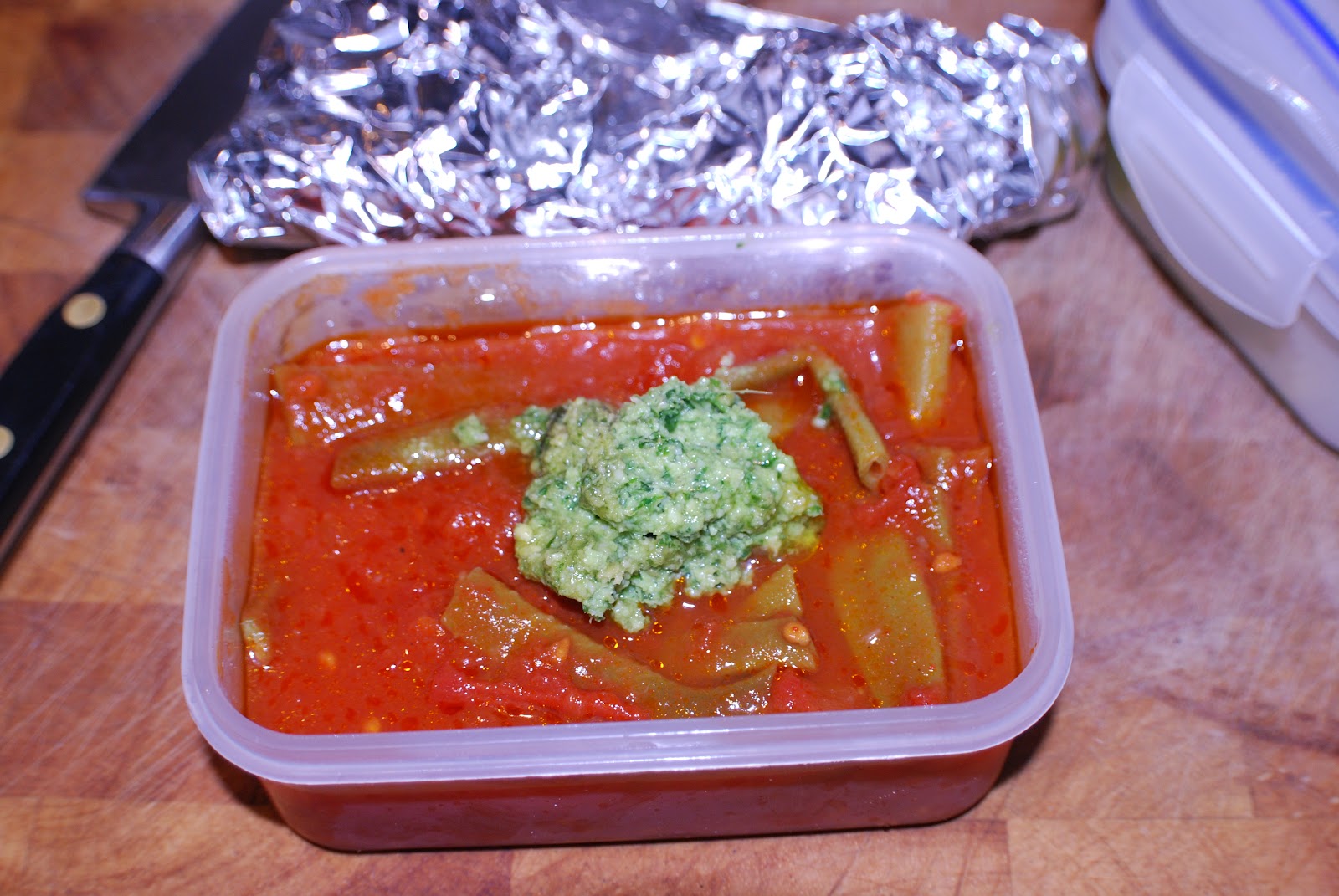
What we did gather on Saturday was processed that afternoon, a pleasant task while listening to the radio. We got about 100g of shelled cobs. Never mind. The milky nuts were blitzed in a spice grinder, as was about 150g of home-grown parsley and basil (the basil was perhaps a quarter of the mix, but dominated the flavour), three garlic cloves and some sea-salt, the lot mixed with a load of grated Parmesan and some olive oil to make a nice soft consistency. DIY pesto, enough for a pasta dish for three of us that evening - so simple, so good - and to 3/4 fill a jar, the pesto covered with a layer of additional oil, to keep in the fridge.
Part of Ruth's packed lunch today is a very wet bean and tomato salad with a huge blob of pesto to enliven it, and the rest will not go to waste. It is not something I'd want to eat every day, or even every week, but as a seasonal boon it's great, and I am happy to have used up the lot. Two years ago we picked far more, but only ate a few as nibbles once they had dried out and hardened, the rest left for another day that never came. That's one of the lessons we are gradually learning, that you can only eat something once, so you might as well enjoy it at its best.

 In monetary terms taking the Parmesan as bought (it was actually a gift from a recent press trip), it and the olive oil would have cost well under £1, while a jar of purchased pesto that size (roughly 400g) would have cost I'd guess £4 or more. And as ours is super-fresh and far more garlicky than shop-bought I reckon it has the edge on taste too.
Not a huge crop this year, however, as along with our apple trees and pear the three nut bushes (they call it nut bush, oh! nut bush etc, thanks Tina) were devastated by the high winds and downpours all summer.
What we did gather on Saturday was processed that afternoon, a pleasant task while listening to the radio. We got about 100g of shelled cobs. Never mind. The milky nuts were blitzed in a spice grinder, as was about 150g of home-grown parsley and basil (the basil was perhaps a quarter of the mix, but dominated the flavour), three garlic cloves and some sea-salt, the lot mixed with a load of grated Parmesan and some olive oil to make a nice soft consistency. DIY pesto, enough for a pasta dish for three of us that evening - so simple, so good - and to 3/4 fill a jar, the pesto covered with a layer of additional oil, to keep in the fridge.
Part of Ruth's packed lunch today is a very wet bean and tomato salad with a huge blob of pesto to enliven it, and the rest will not go to waste. It is not something I'd want to eat every day, or even every week, but as a seasonal boon it's great, and I am happy to have used up the lot. Two years ago we picked far more, but only ate a few as nibbles once they had dried out and hardened, the rest left for another day that never came. That's one of the lessons we are gradually learning, that you can only eat something once, so you might as well enjoy it at its best.

Thursday, 2 February 2012
Bang for Your Buck
A recent piece for Lovefood.com http://www.lovefood.com/journal/opinions/14049/family-mains-course-meals-for-under-3 had me considering the question of maximising flavour for minimal outlay. In that piece I suggested fresh ginger as one of the best ingredients in that light. Garlic is another winner of course. Wild garlic in season, not too far off now, is even better, given if you can find a source where you are allowed, you can pick it for nothing: we are lucky, at the bottom of our garden it grows in wild profusion.
I was pushed to think about this topic again by seeing an advert by the fancy herb and spice bottle people Schwartz. A recipe card series where each includes various herbs etc to make the particular dish is being advertised. Sainsbury's have a rosemary roasted chicken and potatoes one on sale for 99p, down from £1.99, which hopefully means they are failing to take off. In price/weight terms I still think the reduced one will be horrifically expensive for what you get.
If you can't cook, buy a good cookbook - Delia, David, Grigson or pretty much anyone where words are more significant than pictures - and invest in a few packets of herbs and spices - there is no difference I dare say between own-brand dried rosemary and branded - and learn to cook properly. It is one of life's pleasures, not a chore. Learn the techniques so you don't end up a slave to producers, those recipe cards a reminder of what you'll end up paying for supposed convenience.
Subscribe to:
Posts (Atom)